Εμφάνιση αναρτήσεων με ετικέτα Assange UK. Εμφάνιση όλων των αναρτήσεων

Κυριακή 19 Αυγούστου 2012

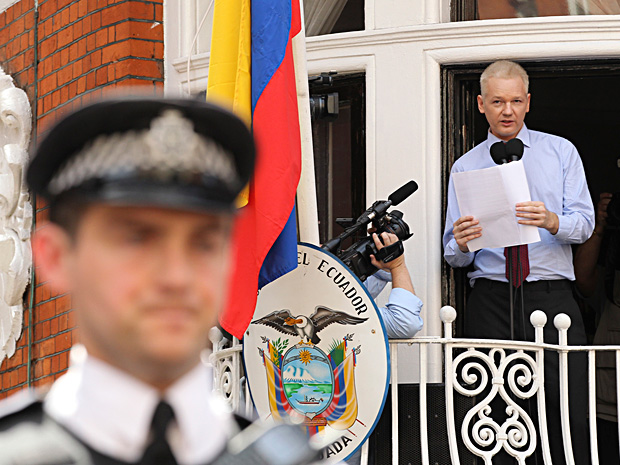
Read the whole speech of Julian Assange


"Can you hear me?

I’m here because I cannot be there today. Thank you for coming. Thank you for your resolve and your generosity of spirit.
On Wednesday night, after a threat was sent to this embassy and the police descended on the building, you came out in the middle of the night to watch over it and you brought the world’s eyes with you.
Inside the embassy, after dark, I could hear teams of police swarming up into the building through the internal fire escape. But I knew that there would be witnesses. And that is because of you
If the UK did not throw away the Vienna convention the other night that is because the world was watching. And the world was watching because you were watching.
The next time somebody tells you that it is pointless to defend those rights we hold dear, remind them of your vigil in the dark before the Embassy of Ecuador.
And how, in the morning, the sun came up on a different world, and a courageous Latin America nation took a stand for justice.
And so, to those brave people. I thank President Correa for the courage has shown in considering and granting me political asylum.
And so I thank the government, and the Foreign Minister Ricardo Patino, who have upheld the Ecuadorian constitution and its notion of universal rights in their consideration of my case.
And to the Ecuadorian people for supporting and defending this constitution.
And I have a debt of gratitude to the staff of this embassy, whose families live in London and who have shown me the hospitality and kindness despite the threats that they received.
This Friday there will be an emergency meeting of foreign of the foreign ministers of Latin America in Washington DC to address this situation.
And so I am grateful to the people and governments of Argentina, Bolivia, Nicaragua, Brazil, Chile, Columbia, El Salvador, Honduras, Mexico, Argentina, Peru, Venezuala, Columbia, and to all o the other Latin American countries who have come to defend the right to asylum.
To the people of the United States, United Kingdom, Sweden and Australia who have supported me in strength, even when their governments have not. And to those wiser heads in government who are still fighting for justice. Your day will come.
To the staff, supporters and source of Wikileaks, whose courage and commitment and loyalty has seen no equal.
To my family and to my children who have been denied their father. Forgive me. We will be reunited soon.
As Wikileaks stands under threat, so does the freedom of expression and the health of our societies. We must use this movement to articulate the choice that is before the government of the United States of America.
Will it return and reaffirm the values it was founded on.
Or will it lurch off the precipice, dragging us all into a dangerous and oppressive world, in which journalists fall silent under the fear of prosecution and citizens must whisper in the dark.
I say that it must turn back.
I ask President Obama to do the right thing. The United States must renounce its witch hunt against Wikileaks.
The United States must dissolve its FBI investigation. The United States must vow that it will not seek to prosecute our staff, or our supporters.
The United States must pledge before the world that it will not pursue journalists for shining a light on the secret crimes of the powerful.
There must be no foolish talk about prosecuting any media organisations, be it Wikileaks or the New York Times.
The US administration’s war on whistleblowers must end.
Thomas Drake and William Binney and John Kirakou and the other heroic US whistleblowers must – they must – be pardoned and compensated for the hardships they have endured as servants o the public record.
And the Army Private who remains in a military prison in Fort Leavenworth, Kansas, who was found by the UN to have endured months of torturous detention in Quantico,Virginia and who has yet – after two years in prison – to see a trial, must be released.
And if Bradley Manning really did as he is accused, he is a hero, an example to us all and one of the world’s foremost political prisoners.
Bradley Manning must be released.
On Wednesday, Bradley Manning spent his 815th day of detention without trial. The legal maximum is 120 days.
On Thursday, my friend, Nabeel Rajab, was sentenced to 3 years for a tweet.
On Friday, a Russian band were sentenced to two years in jail for a political performance.
There is unity in the oppression.
There must be absolute unity and determination in the response ".

Julian Assange for Ecuador: in the morning, the sun came up on a different world, and a courageous Latin American nation took a stand for justice


"On Wednesday night, after a threat was sent to this embassy, the police descended on this building. You came out in the middle of the night to watch over it, and you brought the world's eyes with you Inside this embassy in the dark, I could hear teams of police swarming up inside the building through its internal fire escape. But I knew there would be witnesses, and that is because of you. If the UK did not throw away the Vienna Conventions the other night, it is because the world was watching. And the world was watching because you were watching.So the next time that somebody tells you that it is pointless to defend those rights that we hold dear, remind them of your vigil in the dark before the embassy of Ecuador. Remind them how, in the morning, the sun came up on a different world, and a courageous Latin American nation took a stand for justice"

The Speech of Julian Assange from Ecuador Embassy today (Video)


Σάββατο 18 Αυγούστου 2012

The latest revelation of Assange and Wikileaks: secret Syrian files


Based on Wikileaks Assange would reveal documents about the situation in Syria. From embassy of Ecuador, on 5 July 2012, Assange and his contributors would publish Syria files from " 678,752 different email addresses that have sent emails and 1,082,447 different recipients", Wikileaks said.


Read the Wikileaks announcement:


Today, Thursday 5 July 2012, WikiLeaks began publishing the Syria Files – more than two million emails from Syrian political figures, ministries and associated companies, dating from August 2006 to March 2012.

This extraordinary data set derives from 680 Syria-related entities or domain names, including those of the Ministries of Presidential Affairs, Foreign Affairs, Finance, Information, Transport and Culture.

Over the next two months, ground-breaking stories derived from the files will appear in WikiLeaks (global), Al Akhbar (Lebanon), Al Masry Al Youm (Egypt), ARD (Germany), Associated Press (US), L’Espresso (Italy), Owni (France) and Publico.es (Spain). Other publications will announce themselves closer to their publishing date.

WikiLeaks founder Julian Assange said: "The material is embarrassing to Syria, but it is also embarrassing to Syria’s opponents. It helps us not merely to criticise one group or another, but to understand their interests, actions and thoughts. It is only through understanding this conflict that we can hope to resolve it."

At this time Syria is undergoing a violent internal conflict that has killed between 6,000 and 15,000 people in the last 18 months. The Syria Files shine a light on the inner workings of the Syrian government and economy, but they also reveal how the West and Western companies say one thing and do another.

The range of information extends from the intimate correspondence of the most senior Baath party figures to records of financial transfers sent from Syrian ministries to other nations.

The database comprises 2,434,899 emails from the 680 domains. There are 678,752 different email addresses that have sent emails and 1,082,447 different recipients. There are a number of different languages in the set, including around 400,000 emails in Arabic and 68,000 emails in Russian. The data is more than eight times the size of ’Cablegate’ in terms of number of documents, and more than 100 times the size in terms of data. Around 42,000 emails were infected with viruses or trojans. To solve these complexities, WikiLeaks built a general-purpose, multi-language political data-mining system which can handle massive data sets like those represented by the Syria Files.

In such a large collection of information, it is not possible to verify every single email at once; however, WikiLeaks and its co-publishers have done so for all initial stories to be published. We are statistically confident that the vast majority of the data are what they purport to be.

Case Assange: Ecuador pushes for the support of its South American neighbours.


Ecuador cast its dispute with Britain over asylum for WikiLeaks' founder Julian Assange as a struggle against colonialism on Saturday, drawing growing support from its neighbors in the international diplomatic saga.


Incensed by London's threat to break into the Ecuadorean Embassy where the former hacker is taking refuge, President Rafael Correa's government has accused Britain of bullying and has formally granted Assange asylum.

Britain says it will not allow the anti-secrecy campaigner from Australia to travel to South America because it is obliged to extradite him to Sweden, where he is wanted for questioning over rape and sexual assault allegations.

"They're out of touch. Who do they think they're dealing with? Can't they see that this is a dignified and sovereign government which will not kneel down before anyone?" Correa said in his weekly address on Saturday.

"What a mentality, eh? They have not realized that Latin America is free and sovereign and that we'll not put up with meddling, colonialism of any kind, at least in this country, small, but with a big heart."

Trying to present the affair as an international David versus Goliath battle, Ecuador was hosting this weekend foreign ministers from both the ALBA group of leftist-led Latin American nations and the Union of South American Nations (UNASUR).

On Saturday, Venezuelan President Hugo Chavez called for ALBA members -- which also includes communist-ruled Cuba and Nicaragua, among others -- to stand behind Ecuador.

"Latin America must be respected, our people must be respected, but only united can we earn that respect."

"INVIOLABILITY OF EMBASSIES"

Support for Ecuador appears to be growing in the region.

"Britain ... is wrong. The threat is not only an aggression to Ecuador, it's against Bolivia, it's against South America, against the whole of Latin America," Bolivian President Evo Morales said on Friday.

Ecuadorean state media said other nations including Colombia and Argentina were backing Correa's position.

On Friday representatives of the hemispheric Organization of American States (OAS) called for a foreign ministers' meeting next week over the Assange affair.

Canada and the United States voted against holding the meeting.

"The central issue is not the right of asylum, it is the inviolability of embassies," OAS Secretary General Jose Miguel Insulza said after the vote.

Ecuador, an oil-producing nation of 14.5 million people that seldom finds itself in the global spotlight, is furious Britain said it could make use of an obscure measure to break into its embassy where Assange has been for more than two months.

"Is the threat of a European government to the sovereignty of a South American country not important because we're a small nation?" Ecuadorean Foreign Minister Ricardo Patino said, adding that maybe the region should also discuss the U.S. Guantanamo base in Cuba and Argentina's claim to the Falklands.

The Ecuadorean government shares Assange's fears that he ultimately could be extradited to the United States, which is angry that his WikiLeaks website has leaked hundreds of thousands of secret U.S. diplomatic and military cables.

The leftist Correa, who has high popularity levels and is expected to run for re-election in February 2013, had developed some rapport with Assange during an online interview the WikiLeaks founder did with him this year.

Correa's stance has been largely cheered by Ecuadoreans, and there have been scattered protests at the British Embassy.

"The whole world should back Ecuador for giving Assange asylum and because this country is the first one to promote freedom of expression," said Mary Valenzuela, a 39-year-old restaurant owner.

After WikiLeaks released its deluge of diplomatic cables that laid bare Washington's power-brokering across the globe, Assange became revered as a freedom-of-speech champion in many parts of Latin America, where there is strong tradition of criticizing the United States for meddling.

Leftist nations, and others, have been increasingly turning to new partners like China and Russia in recent years.

However, Europe and the United States are still important trade partners with the region, so Ecuador could suffer should the conflict escalate along commercial lines.

Business leaders and analysts told Reuters this week that long-time U.S. trade benefits for the Andean country are at risk due to the Assange saga.

By Eduardo Garcia / Reuters

Additional reporting by Carlos Quiroga in La Paz and Deisy Buitrago in Caracas; Editing by Andrew Cawthorne and Cynthia Osterman

Meeting of Organization of American States for "the inviolability of embassies" next friday. The occasion is Assange


Next Friday the meeting of Organization of American States, after the decision of Ecuador to grant political asylum to Wikileaks founder, Julian Assange. 


According to press release  the purpose of the meeting will be to "address the situation between Ecuador and the United Kingdom of Great Britain and Northern Ireland regarding the inviolability of the diplomatic premises of Ecuador in the United Kingdom of Great Britain and Northern Ireland in accordance with international law, and to agree on appropriate measures to be adopted."

The Secretary General of the OAS, José Miguel Insulza, stressed to the Council that the resolution approved focuses on "the problem posed by the threat or warning made to Ecuador by the possibility of an intervention into its embassy in London.” “The central issue is not the right of asylum, is the inviolability of embassies," said Secretary General Insulza, who recalled that last year the United Nations Security Council ruled "very strictly on the absolute immunity that diplomatic missions must have in all the countries of the world."

“What is being proposed is that the Foreign Ministers of our organization address this subject and not the subject of asylum nor whether it should be granted to Mr. Julian Assange. That will be discussed between Great Britain and Ecuador, the issue that concerns us is the inviolability of diplomatic missions of all members of this organization, something that is of interest to all of us," said the OAS Secretary General.

The resolution adopted was presented in its original version by the Permanent Representative of Ecuador to the OAS, María Isabel Salvador, who requested the convening of a meeting of OAS Foreign Ministers after her government received a written communication from the United Kingdom warning the government in Quito, she said, that it "should be aware that there is a legal basis in the United Kingdom, the Diplomatic and Consular Premises Act of 1987, which would allow us to take action to arrest Mr. Assange in the existing facilities of the embassy." The South American country yesterday granted diplomatic asylum to Assange, an Australian citizen, who has been in the embassy of Ecuador in London since June 19, 2012.

During the Council meeting, the Representatives of Ecuador, Argentina, Dominica (on behalf of CARICOM), the United States, Panama, Nicaragua, Bolivia, Uruguay, Venezuela, Guatemala, El Salvador, Peru, Brazil, Honduras, Mexico, Canada, Paraguay, Chile and Costa Rica all spoke, as well as the Observers to the OAS from the United Kingdom and Sweden.

Statement of Wikileaks for Assange


Statement on UK threat to storm Ecuadorian embassy and arrest Julian Assange

Thursday 16th August, 3:00am UTC

The UK claims the power to do so under the Diplomatic and Consular Premises Act 1987.

This claim is without basis.

By midnight, two hours prior to the time of this announcement, the embassy had been surrounded by police, in a menacing show of force.

Any transgression against the sanctity of the embassy is a unilateral and shameful act, and a violation of the Vienna Convention, which protects embassies worldwide.

This threat is designed to preempt Ecuador’s imminent decision on whether it will grant Julian Assange political asylum, and to bully Ecuador into a decision that is agreeable to the United Kingdom and its allies.

WikiLeaks condemns in the strongest possible terms the UK’s resort to intimidation.

A threat of this nature is a hostile and extreme act, which is not proportionate to the circumstances, and an unprecedented assault on the rights of asylum seekers worldwide.

We draw attention to the fact that the United Nations General Assembly has unanimously declared in Resolution 2312 (1967) that

"the grant of asylum. . . is a peaceful and humanitarian act and that, as such, it cannot be regarded as unfriendly by any other State."

Pursuant to this resolution, a decision to grant asylum cannot be construed by another State as an unfriendly act. Neither can there be diplomatic consequences for granting asylum.

We remind the public that these extraordinary actions are being taken to detain a man who has not been charged with any crime in any country.

WikiLeaks joins the Government of Ecuador in urging the UK to resolve this situation according to peaceful norms of conduct.

We further urge the UK government to show restraint, and to consider the dire ramifications of any violation of the elementary norms of international law.

We ask that the UK respect Ecuador’s sovereign right to deliver a decision of its own making on Julian Assange’s asylum bid.

Noting that Ecuador has called for emergency summits of OAS and UNASUR in response to this development, WikiLeaks asks those bodies to support Ecuador’s rights in this matter, and to oppose any attempts to coerce a decision.

We note with interest that this development coincides with the UK Secretary of State William Hague’s assumption of executive responsibilities during the vacation of the Prime Minister and Deputy Prime Minister.

Mr Hague’s department, the Foreign and Commonwealth Office, has overseen the negotiations to date with Ecuador in the matter of Mr Assange’s asylum bid.

If Mr Hague has, as would be expected, approved this decision, WikiLeaks calls for his immediate resignation.